Description
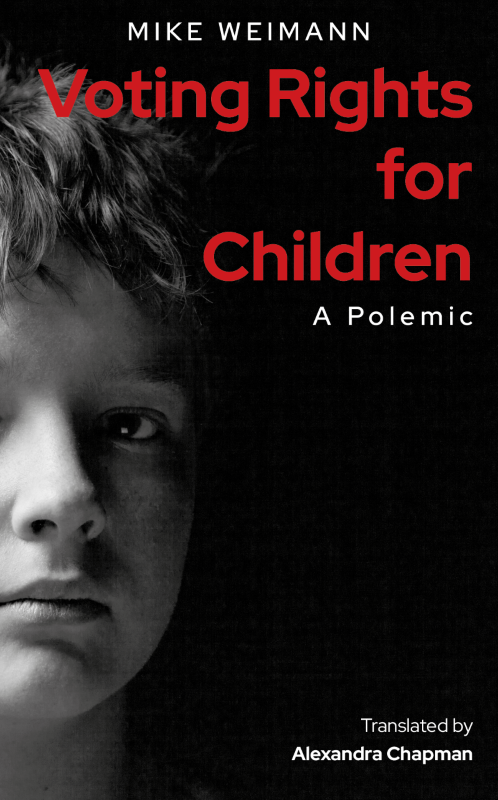
Originally published in German in 2002, Wahlrecht für Kinder – Eine Streitschrift was the first book to make the case for children’s right to vote. This new translation, Voting Rights for Children – a polemic, renders Mike Weimann’s uncompromising logic accessible to an international audience of adults and children. Weimann resolutely sets out to persuade his readers of the necessity of removing illogical barriers to children’s suffrage by refuting every time-honoured objection with his succinct and flawless reasoning. However readers may instinctively feel about children having the vote before reading this book, many will no doubt find themselves challenging their own views on democracy after just a few pages.
Voting Rights for Children – a polemic includes an updated introduction by the author and a foreword by Professor John Wall (Childism Institute, Rutgers University).
January sale – use code 2610 for 10% off (offer ends 31st January)

Thomas Krüger –
“Mike Weimann´s book is an absolute ‘must’ for all who are involved in the rights of children. And, of course for all others. Whether one shares his standpoint or not – at least for now – the reader holds in his or her hands a book that will sufficiently spark a heated discussion concerning the political rights of children, the reason being that the book considers in appropriate detail and seriousness the rights of children to participate in the political arena.”
Thomas Krüger
President of the German Children’s Fund
Professor John Wall –
“Voting Rights for Children – a polemic remains fresh, provocative and eloquent. It is a polemic in the best sense of the word: a call for challenging new thought. The ideas are farsighted. They speak to children and adults, activists and academics, citizens and politicians. Above all, they make crystal clear why children’s suffrage is the key to just and thriving democracies.”
Professor John Wall
Childism Institute, Rutgers University
Derry Hannam –
This is an extraordinary little book. It argues that, despite the UN Convention on the Rights of the Child, children’s rights are poorly developed and protected in Germany and elsewhere, in part because of their exclusion from the right to vote by arbitrary age requirements. Truly polemic in that it challenges and attacks the justifications for the disenfranchisement and denial of personhood to children under the age of 18 in Germany and other Western democracies who are excluded from ‘one person one vote’ participation in electoral processes by presumption of incapacity, immaturity and inexperience due to age. Weimann takes each argument and exposes its excluding unfairness with impeccably ruthless logic.
His main argument is that the right to vote is a human right – i.e. it is independent of the individual abilities of a member of society. He argues that human rights are unconditional: that no obligations can be imposed and no qualifications required. Children should not be excluded by virtue of their skills or lack of them, just as these are not applied to people currently of voting age.
He argues powerfully for the positive consequences of his proposal for children and for society as a whole. If children were to be taken seriously as voters then adults – parents, politicians, educators – would have to rethink how they treat their young fellow citizens. They would also benefit from an end to the patronising of children.
He rejects what he considers to be the unsatisfactory and not to be trusted ‘half-measure’ of proxy voting by adults on behalf of children and the experimental reduction in the voting age to 16; the proposal for 14 to be the voting age; and the neurological cognitive development case of some campaigners for reduction to age 12.
I have known Mike Weimann for some 20 years and share with him a deep unhappiness about the failure of our authoritarian school systems to prepare young people for democratic life. We know from research that more democratic schools foster engagement, learning, well-being and lifelong social participation – most notably in the worldwide network of democratic schools but also though less often in a minority of mainstream schools and school systems. I have personally seen quite young children participate thoughtfully and effectively by voting in such schools. I share with Weimann the belief that children and young people become responsible through exercising responsibility and that adults systematically underestimate and diminish their capacity to do this.
He concludes with a useful list of frequently asked questions such as ‘Are children too immature to vote?’ or ‘Are children too easy to influence?’ referring the reader back to the point in the text where the question has been thoroughly considered and answered.
Although we in the UK lack the luxury of a written constitution we have the lowest age of criminal responsibility in Europe at 10 years and it is hard to see why people who can be held legally accountable for their behaviour should not also be entitled to participate in the process of creating the laws defining that behaviour – namely through voting.
A new edition of this excellent book might benefit from consideration of the implications of developments in social media and artificial intelligence since its initial publication in 2002 and the constitutional considerations could be less specifically German as it reaches out in high quality translation to a wider international audience.
Mike Weimann’s polemic has shifted my way of looking at this issue. It could and should have this effect on as wide a readership as possible.
Derry Hannam
Seaford, UK.
November 2025
Christine Yuihwa Lee –
The basic principles of democracy are universality and equality, but age restrictions mean that children are systematically excluded. The author questions the reasonableness of this exclusion, arguing that children should be included if democracy is universal. For the children’s rights movement, this book, although radical, is also an important contribution to children’s right to participate in the right of expression. Democracy should not be just an adult game/partisan struggle. Care for future generations, intergenerational responsibility and generational justice all need to be done through institutions that allow more people to speak out and more rights/interests to be included.
Christine Yuihwa Lee
Beyond Playmaking
Taiwan
Simon Robinson –
In Voting Rights for Children – A Polemic, Mike Weimann presents a spirited argument for dismantling one of the most entrenched systemic prejudices still present in our societies: the idea that those under the age of 18 should be denied full participation in the democratic process.
I assume he labels his work a “polemic” because the systematic disenfranchisement of under-18s is so pervasive and socially accepted that challenging it is bound to provoke strong reactions. However, I found the book to be a carefully reasoned and calmly presented argument, one that methodically addresses the common justifications used to defend the continued exclusion of young people from voting.
Weimann distils his case into three main points.
First, while under-18s may be young, they are young humans, and as such should be entitled to full human rights.
Second, allowing under-18s to vote would not produce the electoral upheaval some fear. Even if all under-18s voted en masse for a single party, they still represent only a small percentage of the population—too small to have a seismic impact on election outcomes.
Third, many argue that under-18s lack the intelligence, maturity, or experience to vote responsibly and thus would be easily manipulated by politicians offering “gummy bears.” However Weimann notes that public debate would quickly expose such tactics, and also points out that we impose no such competency tests on voters over 18 – it is therefore inappropriate to apply such standards selectively to younger people (it is also hypocritical, since our competence has not been assessed).
This brings us full circle: young people are human beings, and thus deserve full human rights—including the right to vote.
I would like to add a few points of my own.
First (and perhaps polemically), similar arguments have historically been used to deny rights to women, Black people, people with disabilities, and many other groups now universally regarded as deserving of full human rights. If these groups are recognized as full persons, why not under-18s?
Second, such arguments have often been rooted in self-serving prejudices that preserved power for those who already held it.
Third, the claim that young people are too immature to vote implies that everyone over 18 is mature enough to vote wisely—and to resist the siren songs of politicians promising tax breaks and endless economic growth. I can’t help feeling that if that were true, we would already be living in a fair, just, and peaceful world.
Finally, I work with young people, and in my experience they thrive when treated with full respect as equals – when young people trust me enough to share what is really going on for them, those so-called “rebellious attitudes” start to make a great deal of sense given the circumstances they face.
Weimann has written a valuable book that challenges a prejudice which remains all-pervasive in our society. I hope this new English translation helps further the book’s contribution to the ongoing struggle for full human rights for all people—including young people.
Simon Robinson
Adjunct Professor, Okinawa Christian University
Japan